One Backyard, Then a Thousand: Inside the Backyard Tree Nursery Model
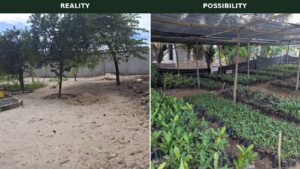
In a dense neighborhood of Dar es Salaam, Tanzania, a woman named Juliana tends a small vegetable garden and cares for a family of four. She also has an enclosed backyard that is about to become part of something much bigger: a tree nursery capable of raising 25,000 seedlings, and possibly far more.
This is ForestPlanet’s Backyard Tree Nursery model, and it is unlike most reforestation efforts you have encountered. There is no purchased land, no imported equipment, and no distant contractor running the show. There is a family, a backyard, a modest stipend, some infrastructure improvements, and hands-on training. Juliana is not a hired hand. She is the operation.
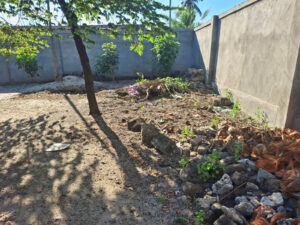
One of millions of modest back yards that can be put to good use.
We know the model works because we have done it before. Esther, who runs a family-based nursery on the Indian Ocean coast in Pangani, grew 25,000 healthy fruit tree seedlings in the backyard of her modest home. After a year of careful nurturing, every seedling was delivered to local families, schools, and communal farmland. No seedlings left behind, no promises unmet. Esther’s nursery, known as BTN #1, answered the only question that mattered before we scaled anything: does this work, at the household level, with a real person running it? It did.
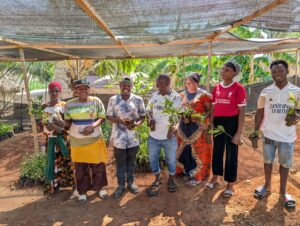
It worked once, we’re doing it again.
BTN #2 applies that same discipline in a bigger city, with different trees suited to different realities. Juliana will raise mango, avocado, jackfruit, tamarind, coconut, breadfruit, and cashew, species chosen to clean the air in a city thick with diesel exhaust from port traffic, to feed people in a place where nutritious produce is not always available, and, eventually, to pay for themselves.
That last point is the crux of it. This campaign funds BTN #2’s first year: Juliana’s stipend, infrastructure, and training. After that, the nursery is built to sustain itself rather than wait on the next round of fundraising. Roughly half of each cohort’s seedlings will be sold at modest market rates to farmers and others able to pay. That revenue covers the direct costs of the following year’s cycle. The rest go to households, schools, and institutions, exactly as they did for Esther.
There is a second, longer horizon for self-sufficiency as well: carbon markets. Carbon project funders generally look for a minimum of scale, something in the neighborhood of a million seedlings out-planted and verified as growing, before a project becomes a viable investment. A single Backyard Tree Nursery will take time to reach that on its own, but a network of them gets there faster. Once that threshold is within reach, carbon revenue becomes a realistic second engine for the model, on top of seedling sales, and closer than it might appear from a single backyard.
The $6,000 needed to fund BTN #2 covers the minimum: infrastructure and the first 25,000 seedlings. But Juliana’s setup has room for more, up to 150,000 seedlings if we include a neighbor’s backyard, and the more we raise now, the bigger and stronger this nursery starts out.
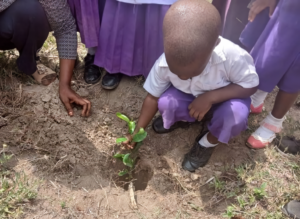
Good trees make good apples, good apples make good trees, and so it goes…
That matters, because BTN #2 is not really about one nursery. It is proof that a model built on family labor, modest capital, and a bit of trust can work anywhere a household has space and willing hands, and that it can eventually stand on its own two feet, without a permanent subsidy.
Juliana’s backyard is the next data point in that proof. We would like your help writing it. We are running a Kickstarter campaign to help fund BTN #2, click here for more information.
—