Air Quality and Trees: A Brief Tutorial and Reminder that It’s All ‘Here’
Given all the outdoor event cancellations and AQI reports being tossed around these days we felt it a good time to revisit what these numbers actually mean. And no surprise what our conclusion will be: planting the right trees in the right place in the right manner at the right time will help the situation. Preferably 20 years ago, but today will do nicely as well.
Trees are not a silver bullet, no one thing is, but they do have billions of years of practice at improving air quality, preventing degradation, and generally keeping the planet habitable. Let’s put more of them to work.
Explaining the SW of PM and AQI
So what?
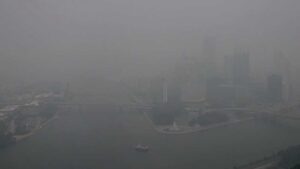
This. This is So What.
First, here’s a quick reminder of what all the numbers and abbreviations mean. “PM” stands for particulate matter, which comes in different sizes:
PM10 — Particles 10 micrometers or smaller in diameter: dust, pollen, mold spores. These particles are big and coarse enough that your nose and throat catch a fair amount of them.
PM2.5 — Particles 2.5 micrometers or smaller, which is about 1/30th the width of a human hair. This is the size that matters most for wildfire smoke, vehicle exhaust, and combustion generally. These particles are small enough to slip past your body’s usual defenses, lodge deep in the lungs, and even cross into the bloodstream. This is the particle/pollutant driving recent Air Quality Index (AQI) alerts.
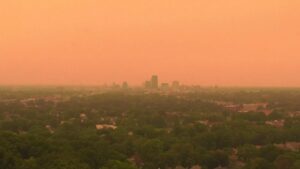
More So What.
AQI is an index that factors in both the size of the PM as well as the density per cubic meter. For PM2.5 specifically, the breakpoints work out roughly like this:
Purple is considered Very Unhealthy — Berkeley Earth’s research puts a full day at that level on par with smoking roughly eight cigarettes, and even a half hour outside adds up. Not a recommended activity for anyone.
Apparently Conifers Collect: How So, and Even More So What
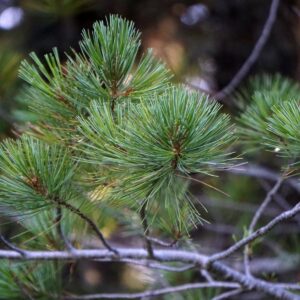
Consider the needles characteristic of conifer, or pine-like trees:
To the rescue.
The geometry of these small needles means that pine-like trees pack more leaf surface area into a given canopy volume than broad-leaf trees like oak, maple, or sycamore. More surface means more places for particles to land. One study measured the difference directly: needled conifers accumulated up to six times the particulate load of broadleaf species over the same growing season.
Conifers also hold onto what they catch better than broadleaf trees do. Needles carry a waxy outer coating that helps particles bind to the surface, and that same coating makes the needle harder to wet. Rain that would make a broad, flat leaf soggy tends to bead up and roll off a needle instead, taking less of the trapped particulate with it. The trait that helps conifers catch particulate matter is largely the same trait that keeps it there afterward.
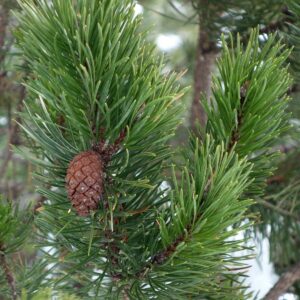
Lots of needles, lots of surface area, not just the pointy end.
This makes pine trees a good choice for open areas, boundaries between properties, and windbreak “rings” around parks and other city parcels. In open settings there is no building or corridor for a dense stand to block, so a conifer windbreak simply keeps working, year-round, as an always-on collector. Calculations change, however, once the setting narrows to a city street, which brings us to the second case.
Locust Trees work well in the Cities
Take the thornless honey locust, a fixture on city streets already: its small, fern-like leaflets let filtered light through rather than casting the dense shade of a maple. It also tolerates the abuse city plantings take, including compacted soil, heat, salt, and drought, which is a large part of why it turns up so often as a street tree in the first place.
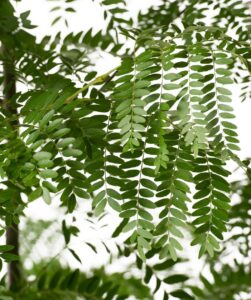
Locust the tree, not the Bug.
Here is why that open structure matters more than it might seem. Research on real street canyons has found that a sparse canopy, covering roughly a quarter to a third of the space overhead, removes more particulate than a dense one. Push canopy coverage much higher and air quality actually gets worse: a thick, unbroken canopy blocks the airflow that would otherwise carry pollutants up and away, trapping them at street level instead. A tree like the honey locust, structurally open by nature, avoids that trap.
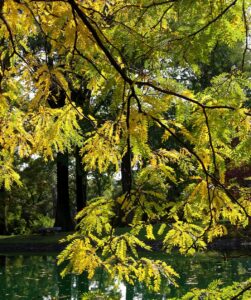
In the autumn, the small leaves fall like tears in rain.
Therefore…
Trees can be part of the air-quality solution, but not all are created equal to all tasks. A conifer earns its keep standing guard over an open boundary; a honey locust earns its keep by staying out of its own way on a crowded street. Same underlying goal, two different mechanisms, and these are just two cases among many.
It’s all HERE, dammit
Once again, current events confirm what we at ForestPlanet say all the time: the right trees, planted anywhere, help everyone everywhere. It’s a small blue marble — a tree planted in Africa, Asia, or the Americas is a tree planted HERE. The Canadian wildfires now filling Mid-Atlantic lungs are burning more than a thousand miles away. Stories like this — pollution and the trees addressing it, both crossing borders with no regard for maps — play out constantly, all over the world.
Our tree planting efforts are not the only solution, nor even a large one. What we can claim is focus: a model built around family and community nurseries that gets trees in the ground reliably, at low cost, and keeps them there. We’re built to scale further, and you’re invited to be part of a successful program.
—
Check out our Linktree to see how you can help.